TGPSC DYEO పరీక్ష విధానం: ప్రశ్నలు, మార్కులు, సమయం, పరీక్ష భాష వివరాలు
Free DYEO Practice Tests – 4000+ Questions, 150+ Tests Free
ఉచితంగా DYEO ప్రాక్టీస్ టెస్టులు – 4000+ ప్రశ్నలు, 150+ Tests ఉచితం
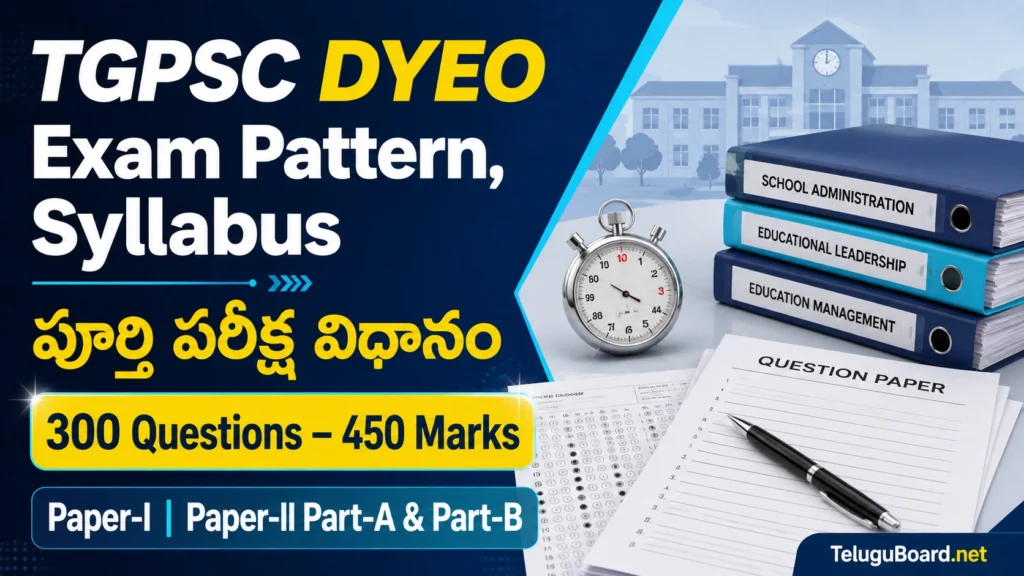
TGPSC నిర్వహించే Deputy Educational Officers / Gazetted Head Master Grade-II రాత పరీక్షకు సిద్ధమవుతున్న అభ్యర్థులు ముందుగా పరీక్ష విధానాన్ని స్పష్టంగా తెలుసుకోవాలి. అధికారిక Scheme of Examination ప్రకారం ఈ పరీక్షలో Paper-Iతోపాటు Paper-IIలో రెండు భాగాలు ఉంటాయి.
రాత పరీక్ష పూర్తిగా Objective Typeలో నిర్వహించబడుతుంది. మొత్తం 300 ప్రశ్నలకు 450 మార్కులు కేటాయించారు. Paper-Iకు 150 నిమిషాలు, Paper-II Part-A మరియు Part-Bకు కలిపి 150 నిమిషాల సమయం ఉంటుంది.
పరీక్షలో ప్రశ్నల సంఖ్య, మార్కుల ప్రాధాన్యం, అందుబాటులో ఉండే సమయం తెలుసుకుని ప్రణాళికాబద్ధంగా సిద్ధమైతే అభ్యర్థులు తమ సమయ నిర్వహణను మెరుగుపరుచుకోవచ్చు.
ముఖ్యమైన వివరాలు
| అంశం | అధికారిక వివరాలు |
|---|---|
| నిర్వహణ సంస్థ | Telangana Public Service Commission – TGPSC |
| పోస్టుల పేరు | Deputy Educational Officers / Gazetted Head Master Grade-II |
| శాఖ | School Education Department |
| పరీక్ష రకం | Written Examination – Objective Type |
| Paper-I | General Studies and General Abilities |
| Paper-I ప్రశ్నలు | 150 |
| Paper-I మార్కులు | 150 |
| Paper-I సమయం | 150 నిమిషాలు |
| Paper-II Part-A | Basic Foundations of Education |
| Part-A ప్రశ్నలు, మార్కులు | 75 ప్రశ్నలు – 150 మార్కులు |
| Paper-II Part-B | Educational Leadership, Administration and Management |
| Part-B ప్రశ్నలు, మార్కులు | 75 ప్రశ్నలు – 150 మార్కులు |
| Paper-II మొత్తం సమయం | Part-A, Part-B కలిపి 150 నిమిషాలు |
| మొత్తం ప్రశ్నలు | 300 |
| మొత్తం మార్కులు | 450 |
| పరీక్ష భాష | English మరియు Telugu – Bilingual |
| అధికారిక ఆధారం | TGPSC Annexure-II Scheme of Examination |
TGPSC DYEO పరీక్ష విధానం
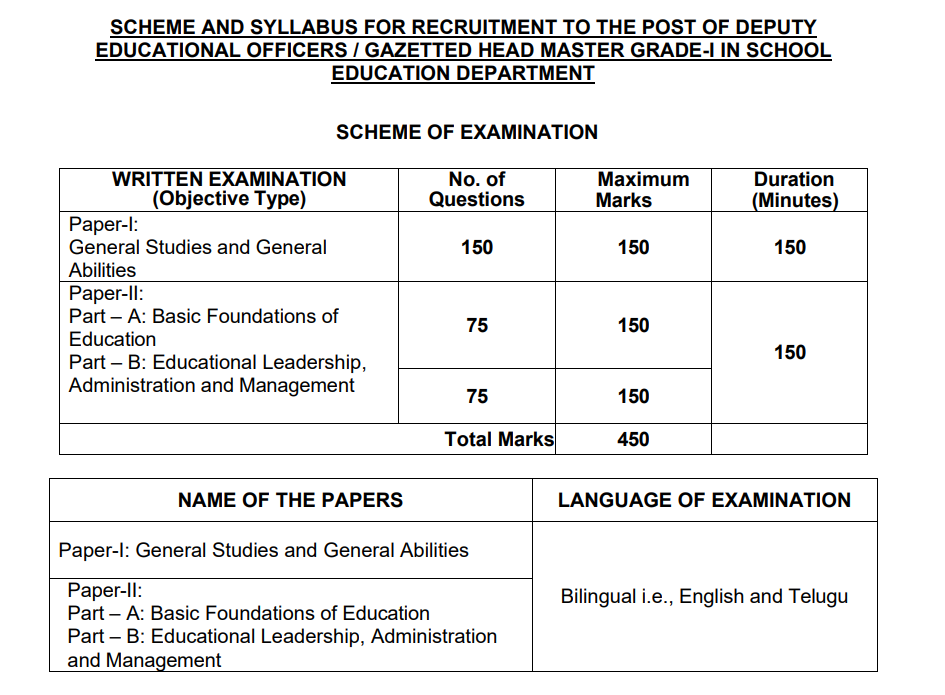
TGPSC DYEO రాత పరీక్షను ప్రధానంగా Paper-I మరియు Paper-IIగా విభజించారు. Paper-IIలో Part-A, Part-B అనే రెండు ప్రత్యేక విభాగాలు ఉంటాయి.
Paper-I: General Studies and General Abilities
Paper-Iలో మొత్తం 150 Objective Type ప్రశ్నలు ఉంటాయి. ఈ పేపర్కు 150 మార్కులు కేటాయించారు. అభ్యర్థులు 150 ప్రశ్నలను పూర్తి చేయడానికి 150 నిమిషాల సమయం పొందుతారు.
అంటే సగటున ఒక్కో ప్రశ్నకు ఒక నిమిషం సమయం అందుబాటులో ఉంటుంది. ప్రశ్నను చదవడం, సరైన సమాధానాన్ని గుర్తించడం, సందేహాస్పద ప్రశ్నలను తిరిగి పరిశీలించడం వంటి వాటిని దృష్టిలో ఉంచుకుని సమయాన్ని వినియోగించాలి.
PAPER-I: GENERAL STUDIES AND GENERAL ABILITIES
- Current affairs – Regional, National and International.
- International Relations and Events.
- General Science; India’s Achievements in Science and Technology.
- Environmental issues; Disaster Management- Prevention and Mitigation
Strategies. - Economic and Social Development of India and Telangana.
- Physical, Social and Economic Geography of India.
- Physical, Social and Economic Geography and Demography of Telangana.
- Socio-economic, Political and Cultural History of Modern India with special
emphasis on Indian National Movement. - Socio-economic, Political and Cultural History of Telangana with
special emphasis on Telangana Statehood Movement and
formation of Telangana state. - Indian Constitution; Indian Political System; Governance and Public Policy.
- Social Exclusion; Rights issues such as Gender, Caste, Tribe, Disability etc. and
inclusive policies. - Society, Culture, Heritage, Arts and Literature of Telangana.
- Policies of Telangana State.
- Logical Reasoning; Analytical Ability and Data Interpretation.
- Basic English. (10th Class Standard)
Paper-II Part-A: Basic Foundations of Education
Paper-II Part-Aలో మొత్తం 75 ప్రశ్నలు ఉంటాయి. ఈ భాగానికి 150 మార్కులు కేటాయించారు.
అధికారిక ప్రశ్నలు–మార్కుల విభజన ప్రకారం Part-Aలో ప్రతి ప్రశ్నకు రెండు మార్కుల ప్రాధాన్యం ఉంటుంది. అందువల్ల ఈ విభాగంలో చేసే ప్రతి సరైన సమాధానం మొత్తం స్కోరుపై గణనీయమైన ప్రభావం చూపుతుంది.
PAPER-II PART – A
BASIC FOUNDATIONS OF EDUCATION
I. Education and Indian Constitution: Preamble and its Educational Philosophy;
Freedom, Democracy and Right to Education; RTE Act; National and State
Educational Policies in Independent India; Recommendations of various Education
Commissions and Committees and National Curriculum Frameworks.
II. Education in Ancient Indian Knowledge Systems; Education in Colonial and
Postcolonial India; Educational Implications of Vedanta, Buddhism, Jainism, Islam
and Christianity;
III. 1.Epistemological Foundations of Education: Mind, Reason, Logic, and thinking in
Children; Scientific and Religious Knowledge and Experience; Intellectual
Developments during Renaissance and Enlightenment in Europe and Critique on
Eurocentric Colonial models of thinking in education;
- Educational Philosophies of Swami Vivekananda, MK Gandhi, Rabindranath
Tagore, Sri Aurobindo, Jiddu Krishnamurthy, Jyothi Rao Phule, Dr.B.R. Ambedkar,
John Dewey and Paulo Freire; 3. Education and Values: Ethical, Moral and Spiritual
Foundations of Education; Art, Music and Aesthetics in Education; Liberal
Education;
IV. 1. Culture, Socialisation, Modernity and Education; Equality, Equity, Diversity,
Plurality &Inclusion; Civic Education ; 2. Liberalisation, Social Change and
Education; Educational Opportunities, Social Justice and Education; Education for
the disadvantaged and Weaker sections of Society; Public Education: Learning
Crises in Contemporary India; Privatization in Education; Public Policy in Education; - Teacher Autonomy, Accountability and Responsibility; 4.; Sustainable
Development and Environmental Education ; 5.Basics in Economics of Education
and Educational Finance.
V. 1. Understanding Children and their cultural and Individual Differences; Growth and
Development: Infancy to Old Age ; 2. Psychology of Human Development: Child
Development- Social, Cognitive, Language/Linguistic, Emotional, Moral and
Aesthetic Areas; Motivation, Learning and Development; 3. Personality and
Understanding Self, Memory, Cognition, Creativity and Intelligence; 4, Educating
and addressing the needs of Exceptional Children and Children with Disabilities
including Sensory, Physical Social and Emotional and Mental Challenges;
5.Principles and Styles of Guidance, Counselling and Mentoring; 6. Early Childhood
Care and Education.
VI. 1. Pedagogical Process, Teaching -Learning Methods and Innovative Practices in
Education; 2. Disciplines of Knowledge; Curriculum Processes and Organization of
Knowledge; 3. Skill Development and Vocational Education; 4. Measurement,
Assessment and Evaluation in Education: Evaluation and Assessment of Children
and Teachers’ Performance and Evaluation of Quality in Education; 5. Logical and
Statistical Reasoning in Educational Research;; 6. Critical Thinking and Creative
Imagination in Children; 7. Principles and Styles of Guidance, Counselling and
Mentoring ; 8. Application of ICT, AI and Digital Technologies in Education.
VII. 1.Mother Tongue, Multilingualism and Language Policy; 2. Adult, Non-Formal and
Life-Long Education; 3. Media and Communication in Education; 4. Health, Yoga
and Physical Education; 5. Education for National Integration and International
Understanding.
Paper-II Part-B: Educational Leadership, Administration and Management
Paper-II Part-Bలో కూడా మొత్తం 75 ప్రశ్నలు ఉంటాయి. ఈ విభాగానికి 150 మార్కులు కేటాయించారు.
Part-Bలో కూడా ప్రతి ప్రశ్నకు రెండు మార్కుల చొప్పున ప్రాధాన్యం ఉంటుంది. Part-Aతో సమానంగా Part-Bను కూడా అభ్యర్థులు ముఖ్యమైన స్కోరింగ్ విభాగంగా పరిగణించాలి.
PAPER – II PART – B
EDUCATIONAL LEADERSHIP, ADMINISTRATION AND MANAGEMENT
I. 1. School Education: Present Scenario; Programmes and Policies in School
Education and Recent Initiatives in School Education at State and National Level;
Educational Management at the State and National Level. 2.School Administration:
Macro Perspectives; School Administration at the National and State Level ; School
Administration at the District and Sub-district Level. 3.School Management and
Administration: Micro Perspectives; Building Mission and Vision of the
School/institutions; Institutional Development Planning and Implementation of
Institutional Plan.
II. 1. School Performance and Evaluation: Student and Teacher Learning, Teacher
Professional Development and Community Involvement in School Management and
Performance; Evaluation of School Performance. 2. School Quality Management:
School Quality: Concept and Dimensions/indicators; Total Quality Management;
Institutional Appraisal and SWOT Analysis; Professional Development of Staff,
Appraisal and Accountability;
III. 1. Leadership in Educational Management: Leadership Behaviour and Leadership
Styles; Transformational Leadership in educational management- 2. Educational
Management: Theories, Models and Practices in Educational Management;
Principles and Techniques in Educational Management; Management of Innovations;
Dimensions of Educational Management and Various Emerging Approaches in
Educational Management; 3. Nature of Organisational Behaviour: Group Dynamics
and Team Building Theories of Motivation: Implications for Management ; Selfmanagement vis-a-vis Educational Management
IV. 1. Decentralised Management in Education :Decentralized Planning; District and
Sub-district Management; Role of local self-bodies, VEC and Gram Panchayat;
Community Participation.
- Decision Making in Educational Management: Concept, importance and types of
Decision-Making; Decision making process ; 3. Management of Interpersonal
Relations and Conflict Management– Communication in Educational Management :
Meaning and Relevance of Communication in Educational Management;
Organizational Communication ; Effective Communication Approaches
V. Institutional Management and Management of Curriculum: Classroom Management
(Instructional Management); Curriculum Transaction; Management of Evaluation;
Management of Academic Resources and Management of Curricular & Co-curricular
Programmes & Activities; Action Research Approach in Educational Management
VI. 1. Management of Financial Resources :Educational Finance: meaning Importance
and Scope; Cost and Budgeting; Accounting and Auditing and Resource Mobilization.
2.Management of Human and Administrative Resources : Management of Student
Support System; Management of Administrative Resources; 3. Management of
Human Resources–Management of Infrastructure :Management of Physical
Resources; Utilization of Infrastructural Resources. 4.Total Quality Management:
Quality Control, Quality Assurance and Indicators; Tools of Management ; Strategies
for Quality Improvement; Role of different Agencies and Quality concerns and issues
for research
VII. 1. Policy Formulation and Policy Planning : Organizational Structure; Role of
National Bodies; - Centre-State Relations : Coordination, Networking, Partnership and Linkages —
Management of Special Schools and Children: Recent Developments and Policies of
Inclusion; 3. Designing School Health Policies in aligning with National and State
Level Health Policies; Designing and Managing Innovative Practices in School
Education ; 4. Building Regional, State, National and International Relationships for
School Development; 5. Roles & Applications of Information and Communication
Technologies (ICTs) in Educational Administration and Management.
Paper-II సమయం
Paper-IIలోని Part-A, Part-B కలిపి మొత్తం 150 ప్రశ్నలు ఉంటాయి. రెండు భాగాలకు కలిపి 150 నిమిషాల సమయం ఉంటుంది.
అంటే Paper-IIలో కూడా సగటున ఒక్కో ప్రశ్నకు ఒక నిమిషం మాత్రమే అందుబాటులో ఉంటుంది. అయితే ప్రతి ప్రశ్నకు రెండు మార్కులు ఉండటం వల్ల వేగంతోపాటు సమాధానాల ఖచ్చితత్వం కూడా చాలా ముఖ్యమైనది.
మార్కుల విభజన ఎలా ఉంది?
మొత్తం 450 మార్కుల్లో:
- Paper-Iకు 150 మార్కులు కేటాయించారు.
- Paper-II Part-Aకు 150 మార్కులు కేటాయించారు.
- Paper-II Part-Bకు 150 మార్కులు కేటాయించారు.
- Paper-II మొత్తం 300 మార్కులకు ఉంటుంది.
- Paper-Iతో పోలిస్తే Paper-IIకు రెండింతల మార్కుల ప్రాధాన్యం ఉంది.
అందువల్ల అభ్యర్థులు Paper-Iను నిర్లక్ష్యం చేయకుండా సిద్ధమవుతూ, Paper-II Part-A మరియు Part-Bకు ఎక్కువ సాధన సమయం కేటాయించడం ఉపయోగకరంగా ఉంటుంది.
పరీక్ష భాష
అధికారిక వివరాల ప్రకారం TGPSC DYEO పరీక్ష Bilingual విధానంలో English మరియు Telugu భాషల్లో ఉంటుంది.
Paper-Iతోపాటు Paper-II Part-A, Part-B ప్రశ్నలు కూడా తెలుగు మరియు ఇంగ్లీష్ భాషల్లో అందుబాటులో ఉంటాయి. తెలుగు మాధ్యమ అభ్యర్థులకు ప్రశ్నలను అర్థం చేసుకోవడంలో ఇది ఉపయోగపడుతుంది.
అయితే అధికారిక పదాలు, విద్యా పరిపాలనకు సంబంధించిన సాంకేతిక పదాలు ఇంగ్లీష్లో ఉండే అవకాశం ఉన్నందున ముఖ్యమైన English terminologyపై కూడా అవగాహన పెంచుకోవాలి.
పరీక్ష కోణంలో ముఖ్యమైన విశ్లేషణ
Paper-IIకు అత్యధిక ప్రాధాన్యం
మొత్తం 450 మార్కుల్లో Paper-II నుంచే 300 మార్కులు ఉంటాయి. అంటే మొత్తం మార్కుల్లో ప్రధాన భాగం Paper-II Part-A, Part-B నుంచే వస్తుంది.
అభ్యర్థులు తమ రోజువారీ అధ్యయన ప్రణాళికలో Paper-IIకు తగినంత సమయం కేటాయించాలి.
మూడు విభాగాలకు సమాన మార్కులు
Paper-I, Paper-II Part-A, Paper-II Part-B విభాగాలకు ఒక్కొక్కటికి 150 మార్కులు ఉన్నాయి. అయితే ప్రశ్నల సంఖ్యలో వ్యత్యాసం ఉంది.
Paper-Iలో 150 ప్రశ్నలకు 150 మార్కులు ఉండగా, Paper-IIలోని ప్రతి భాగంలో 75 ప్రశ్నలకు 150 మార్కులు ఉన్నాయి.
సమయ నిర్వహణ కీలకం
Paper-Iలో 150 ప్రశ్నలకు 150 నిమిషాలు, Paper-IIలో 150 ప్రశ్నలకు 150 నిమిషాలు ఉంటాయి. అందువల్ల ప్రశ్నలపై ఎక్కువ సమయం ఖర్చు చేయకుండా వేగంగా నిర్ణయం తీసుకునే సామర్థ్యాన్ని పెంచుకోవాలి.
Preparation Strategy – సిద్ధత ప్రణాళిక
1. మూడు విభాగాలకు ప్రత్యేక ప్రణాళిక రూపొందించండి
Paper-I, Paper-II Part-A, Paper-II Part-Bలను మూడు ప్రత్యేక విభాగాలుగా పరిగణించి చదవాలి. ప్రతి విభాగంలో సాధించిన మార్కులను విడిగా పరిశీలించాలి.
2. Paper-IIకు ఎక్కువ సమయం కేటాయించండి
Paper-II మొత్తం 300 మార్కులకు ఉండటం వల్ల రోజువారీ చదువు సమయంలో Part-A, Part-Bకు ఎక్కువ ప్రాధాన్యం ఇవ్వాలి.
3. రోజూ Objective Questions సాధన చేయండి
రాత పరీక్ష Objective Typeలో ఉంటుంది. కాబట్టి అంశాన్ని చదవడంతోపాటు రోజూ MCQs సాధన చేయడం అవసరం.
4. ఒక్కో ప్రశ్నకు ఒక నిమిషం సాధన చేయండి
Mock Tests రాసేటప్పుడు 150 ప్రశ్నలను 150 నిమిషాల్లో పూర్తి చేసేలా సాధన చేయాలి. మొదటి దశలో తేలికైన ప్రశ్నలకు సమాధానాలు ఇచ్చి, తరువాత సందేహాస్పద ప్రశ్నలకు వెళ్లడం ఉపయోగకరం.
5. తప్పుల విశ్లేషణ చేయండి
ప్రతి Practice Test తరువాత తప్పుగా సమాధానం ఇచ్చిన ప్రశ్నలను గుర్తించాలి. తప్పు ఎందుకు జరిగిందో తెలుసుకుని సంబంధిత అంశాన్ని తిరిగి చదవాలి.
6. Telugu–English పదజాలాన్ని సిద్ధం చేసుకోండి
పరీక్ష రెండు భాషల్లో ఉన్నప్పటికీ కొన్ని అధికారిక విద్యా పదాలు ఇంగ్లీష్లో సులభంగా అర్థమవుతాయి. ముఖ్యమైన తెలుగు–ఇంగ్లీష్ పదజాలంతో ప్రత్యేక నోట్స్ తయారు చేసుకోవాలి.
7. పూర్తి స్థాయి Mock Tests రాయండి
చివరి దశలో Paper-Iకు 150 నిమిషాలు, Paper-IIకు 150 నిమిషాలు కేటాయించి పూర్తి స్థాయి పరీక్షలు రాయాలి. దీనివల్ల పరీక్ష సమయంలో వేగం, ఖచ్చితత్వం, ఒత్తిడి నిర్వహణ మెరుగుపడతాయి.
Important Points – ముఖ్యమైన అంశాలు
- TGPSC DYEO రాత పరీక్ష Objective Typeలో ఉంటుంది.
- Paper-Iలో 150 ప్రశ్నలు, 150 మార్కులు ఉంటాయి.
- Paper-II Part-Aలో 75 ప్రశ్నలు, 150 మార్కులు ఉంటాయి.
- Paper-II Part-Bలో 75 ప్రశ్నలు, 150 మార్కులు ఉంటాయి.
- మొత్తం పరీక్షలో 300 ప్రశ్నలు, 450 మార్కులు ఉంటాయి.
- Paper-I పరీక్ష సమయం 150 నిమిషాలు.
- Paper-II Part-A, Part-Bకు కలిపి 150 నిమిషాలు ఉంటుంది.
- పరీక్ష English మరియు Telugu భాషల్లో Bilingual విధానంలో ఉంటుంది.
Important Highlights
- మొత్తం రాత పరీక్ష 450 మార్కులకు నిర్వహించబడుతుంది.
- పరీక్షలో మొత్తం 300 Objective Type ప్రశ్నలు ఉంటాయి.
- Paper-Iకు 150 మార్కులు కేటాయించారు.
- Paper-II Part-A, Part-B కలిపి 300 మార్కులు ఉంటాయి.
- Paper-IIలోని ఒక్కో భాగంలో 75 ప్రశ్నలు, 150 మార్కులు ఉంటాయి.
- Paper-I, Paper-IIలకు ఒక్కొక్కటికి 150 నిమిషాల సమయం ఉంటుంది.
- మొత్తం పరీక్ష English మరియు Telugu భాషల్లో ఉంటుంది.
- Paper-IIకు మొత్తం మార్కుల్లో అధిక ప్రాధాన్యం ఉంది.
Conclusion
TGPSC DYEO పరీక్షలో Paper-I, Paper-II Part-A, Paper-II Part-B అనే మూడు ప్రధాన విభాగాలు ఉంటాయి. మొత్తం 300 ప్రశ్నలకు 450 మార్కులు కేటాయించడం వల్ల ప్రతి విభాగంలో సమతుల్యమైన సిద్ధత అవసరం.
ప్రత్యేకంగా Paper-IIకు 300 మార్కులు ఉండటం వల్ల విద్యా పునాదులు, విద్యా నాయకత్వం, పరిపాలన మరియు నిర్వహణకు సంబంధించిన విభాగాలపై అభ్యర్థులు ఎక్కువ సాధన చేయాలి. సమయపాలనతో Mock Tests రాయడం ద్వారా పరీక్షలో మెరుగైన స్కోరు సాధించే అవకాశం పెరుగుతుంది.
TGPSC DYEO పరీక్షకు సంబంధించిన తాజా సమాచారం, Practice Tests మరియు విద్యా సంబంధిత అప్డేట్ల కోసం TeluguBoard.netను అనుసరించండి.
FAQs
1. TGPSC DYEO పరీక్ష మొత్తం ఎన్ని మార్కులకు ఉంటుంది?
TGPSC DYEO రాత పరీక్ష మొత్తం 450 మార్కులకు ఉంటుంది.
2. DYEO పరీక్షలో మొత్తం ఎన్ని ప్రశ్నలు ఉంటాయి?
Paper-I, Paper-II Part-A, Part-B కలిపి మొత్తం 300 ప్రశ్నలు ఉంటాయి.
3. TGPSC DYEO పరీక్ష Objective Typeలో ఉంటుందా?
అవును. అధికారిక Scheme of Examination ప్రకారం రాత పరీక్ష Objective Typeలో ఉంటుంది.
4. Paper-Iలో ఎన్ని ప్రశ్నలు ఉంటాయి?
Paper-Iలో మొత్తం 150 ప్రశ్నలు ఉంటాయి. ఈ పేపర్కు 150 మార్కులు కేటాయించారు.
5. Paper-II Part-Aలో ఎన్ని ప్రశ్నలు, మార్కులు ఉంటాయి?
Paper-II Part-Aలో 75 ప్రశ్నలు, 150 మార్కులు ఉంటాయి.
6. Paper-II Part-Bలో ఎన్ని ప్రశ్నలు ఉంటాయి?
Paper-II Part-Bలో 75 ప్రశ్నలు ఉంటాయి. ఈ భాగానికి 150 మార్కులు కేటాయించారు.
7. Paper-IIకు ఎంత సమయం ఉంటుంది?
Paper-II Part-A, Part-B రెండింటికీ కలిపి 150 నిమిషాల సమయం ఉంటుంది.
8. TGPSC DYEO పరీక్ష తెలుగు భాషలో ఉంటుందా?
అవును. పరీక్ష English మరియు Telugu భాషల్లో Bilingual విధానంలో ఉంటుంది.
9. Paper-I, Paper-IIలో దేనికి ఎక్కువ మార్కులు ఉన్నాయి?
Paper-Iకు 150 మార్కులు ఉండగా, Paper-II Part-A, Part-B కలిపి మొత్తం 300 మార్కులు ఉన్నాయి.